
The Care - Flaming Sword (the Powermix) Dj Raf (2024)
The neon hum of the "Data-Pulse" club wasn't just music; it was a physical weight. Under the strobe lights, stood at the altar of the booth, his hands hovering over the decks like a surgeon. The crowd was a sea of rhythmic motion, but he was looking for something deeper—a frequency that could break the digital fever of the city.
As the track reached its crescendo, the line between the machine and the soul blurred. For those six minutes, the "PowerMix" wasn't just a song; it was a rescue mission. When the final echo faded into a shimmering reverb, the room stayed silent for a heartbeat, vibrating with the ghost of the sound, before erupting into a roar that shook the very foundation of the city. The Care - Flaming Sword (The PowerMix) DJ RAF
He slid the fader, and the first tectonic notes of began to bleed into the room. But this wasn't the radio edit. This was the PowerMix . The neon hum of the "Data-Pulse" club wasn't
In the center of the floor, a girl in chrome mesh stopped dancing and simply stared at the ceiling. To her, the music felt like a heavy velvet curtain being drawn back. The "PowerMix" lived up to its name, layering heavy, industrial percussion over the ethereal melody, creating a soundscape that felt like a cathedral being built in the middle of a riot. As the track reached its crescendo, the line
The bass didn't just kick; it growled, a low-end predator prowling through the subwoofers. As the synth line—sharp and bright as its namesake weapon—pierced through the smoke, the atmosphere shifted. The club's holographic displays flickered, casting long, jagged shadows that danced like ancient warriors across the walls.
RAF twisted a dial, filtering the highs until the melody sounded like it was coming from underwater, then— snap —he brought it back at full volume. The release was explosive. It was the "Flaming Sword" swinging through the darkness, cutting the tension of the week, the month, the year.
eFatigue gives you everything you need to perform state-of-the-art fatigue analysis over the web. Click here to learn more about eFatigue.
The Care - Flaming Sword (the Powermix) Dj Raf (2024)
Welds may be analyzed with any fatigue method, stress-life, strain-life or crack growth. Use of these methods is difficult because of the inherent uncertainties in a welded joint. For example, what is the local stress concentration factor for a weld where the local weld toe radius is not known? Similarly, what are the material properties of the heat affected zone where the crack will eventually nucleate. One way to overcome these limitations is to test welded joints rather than traditional material specimens and use this information for the safe design of a welded structure.
One of the most comprehensive sources for designing welded structures is the Brittish Standard Fatigue Design and Assessment of Steel Structures BS7608 : 1993. It provides standard SN curves for welds.
Weld Classifications
For purposes of evaluating fatigue, weld joints are divided into several classes. The classification of a weld joint depends on:
- the macroscopic geometry of the pieces welded,
- the direction of the cyclic stresses, and
- the location of the crack that leads to failure.
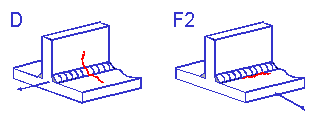
Two fillet welds are shown below. One is loaded parallel to the weld toe ( Class D ) and the other loaded perpendicular to the weld toe ( Class F2 ).
It is then assumed that any complex weld geometry can be described by one of the standard classifications.
Material Properties
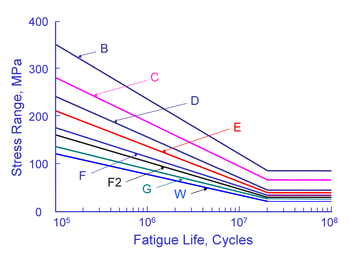
The curves shown above are valid for structural steel welds. Fatigue lives are not dependant on either the material or the applied mean stress. Welds are known to contain small cracks from the welding process. As a result, the majority of the fatigue life is spent in growing these small cracks. Fatigue lives are not dependant on material because all structural steels have about the same crack growth rate. The crack growth rate in aluminum is about ten times faster than steel and aluminum welds have much lower fatigue resistance. Welding produces residual stresses at or near the yield strength of the material. The as welded condition results in the worst possible residual or mean stress and an external mean stress will not increase the weld toe stresses because of plastic deformation. Fatigue lives are computed from a simple power function.

The constant C is the intercept at 1 cycle and is tabulated in the standard. This constant is much larger than the ultimate strength of the material.
The standard is only valid for fatigue lives in excess of 105 cycles and limits the stress to 80% of the yield strength. Experience has shown that the SN curves provide reasonable estimates for higher stress levels and shorter lives. In eFatigue, the maximum stress range permitted is limited by the ultimate strength of the material for all weld classes.
Design Criteria
Test data for welded members has considerable scatter as shown below for butt and fillet welds.
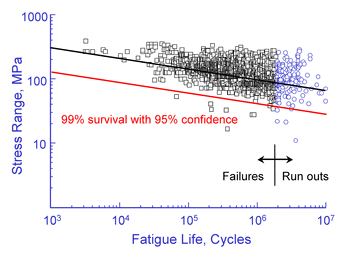
Some of this scatter is reduced with the classification system that accounts for differences between the various joint details. The standard give the standard deviation of the various weld classification SN curves.
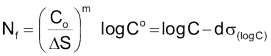
The design criteria d is used to determine the probability of failure and is the number of standard deviations away from the mean. For example d = 2 corresponds to a 2.3% probability of failure and d = 3 corresponds to a probability of failure of 0.14%.
© 2026 — Swift Vault