Play Date ★
Impressive design. In Record Time. No coding.
Download Windows executable and try it now with a free 30-day trial.
Try For Free
Impressive design. In Record Time. No coding.
Download Windows executable and try it now with a free 30-day trial.
Try For FreeWhenever you need to build an autorun menu for CD, DVD or USB drive to execute automatically any time a user inserts that media into the computer - Autoplay Menu Designer delivers an easy, convenient and 100% coding-free way to do this! Although using its vast capabilities you can create any full-functional interactive application in few minutes even if you have literally no programming skills at all.
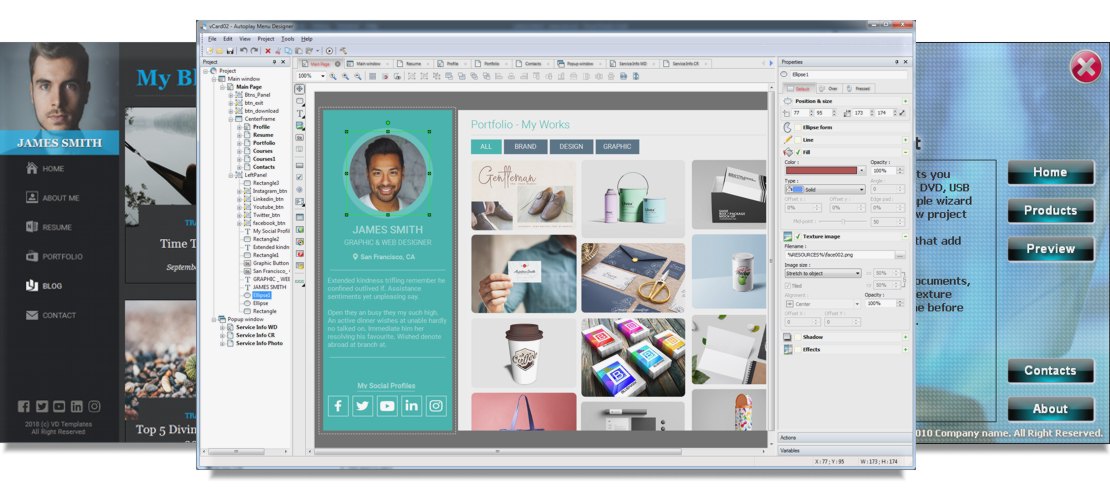
Use apps built with the Autoplay Menu Designer for easy software delivery, to create spectacular presentations, manuals and e-books, business cards and brochures, to display your personal music and video collections, to create a birthday slideshow or a multimedia greeting card, for exquisite family albums and many, many more!
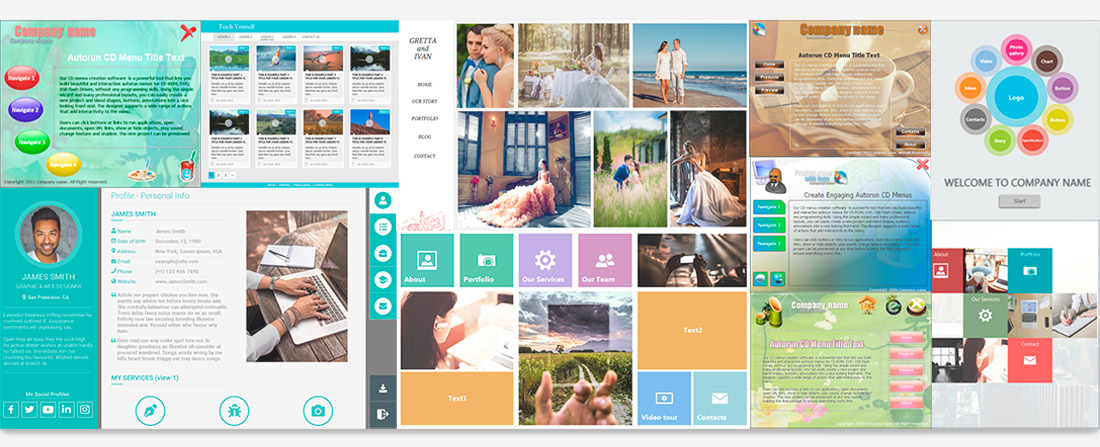
Autoplay Menu Designer's rich interactivity allows implementing almost any idea and fulfilling any need you may have as a developer. Unlimited screens, over 25 customizible objects including graphics, texts, buttons, slide-show, image gallery, media and more to make your app respectable and affecting.
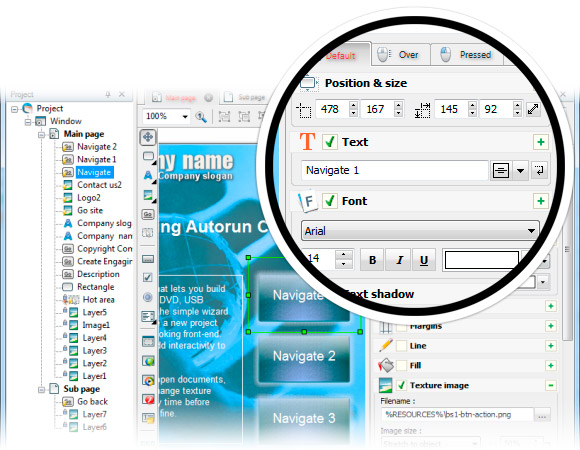
You can make any element of your application interactive and assign one of the impressive range of available actions to it: execute a program, open PDF or PowerPoint presentation, play and control videos and sounds, send an e-mail, open the given URL and much more...

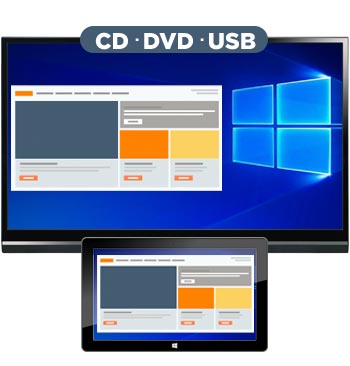
Build a Windows executable autorun application to distribute your products on CD/DVD/USB for Windows users. Use unlimited native Windows functionality: autorun opportunity, interaction with external apps, access to registry and etc.
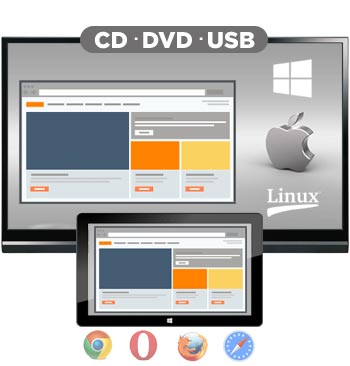
Build a Web/HTML5 application for all devices(PC, MAC, Tables) that have a browser. Web app don't request an Internet connection, can be running in a browser as well as an executable application from CD/DVD/USB drives.

Build a Web/HTML5 application, upload it to our hosting service and distribute as a link to Website.
Download Windows executable and try it now with a free 30-day trial.
Get Started Now










Ultimately, a play date is far more than a play session; it is a rehearsal for life. It is where we first learn how to share our space, how to resolve conflict without tears, and how to find joy in the presence of another. Whether it ends in a lifelong friendship or a messy room and a quick goodbye, the play date leaves an indelible mark on the participant, teaching them the most difficult and rewarding skill of all: how to get along.
The concept of a "play date" is often viewed as a simple childhood logistical necessity—a scheduled block of time where parents drop off their children to burn off energy. However, beneath the surface of snacks and scattered toys, the play date serves as a sophisticated laboratory for human development. It is the first arena where children step outside the curated safety of the family unit to navigate the complexities of social contracts, empathy, and identity. Play Date
Furthermore, these interactions provide a vital mirror for self-reflection. In the solitude of a bedroom, a child’s imagination is absolute. In the company of a peer, that imagination is challenged. If one child declares a cardboard box is a spaceship and the other insists it is a hospital, a cognitive friction occurs. This "divergent thinking" forces children to expand their perspective, recognizing that others possess internal worlds as vivid and valid as their own. This is the birth of empathy: the realization that the "other" is not just a character in their story, but the protagonist of their own. Ultimately, a play date is far more than
At its core, a play date is an exercise in negotiation. Unlike interactions with parents or siblings, where roles are often fixed by hierarchy or long-standing habits, a play date presents a blank slate. Children must decide, often without adult intervention, whose house rules apply and which game takes precedence. When two children agree to build a Lego castle instead of playing tag, they are practicing the art of compromise. They are learning that their individual desires must sometimes bend to maintain the harmony of the collective—a fundamental pillar of civil society. The concept of a "play date" is often
In the modern era, the play date has taken on a more structured, almost professionalized tone. With the rise of "helicopter parenting" and packed extracurricular schedules, the spontaneous "neighborhood roam" of previous generations has been replaced by the "calendar invite." While some critics argue this robs children of independence, the scheduled play date ensures that social connection remains a priority in a digital age. It carves out a sacred space for boredom and invention—two states of being that are increasingly rare but essential for creativity.
Download Windows executable and try it now with a free 30-day trial.
Download Now